

+86 571 8659 2517

+86 180 5841 8258

info@zmuni.com


This article provides a comprehensive overview of key regulatory developments in the food sector in September 2026, both in China and internationally. It focuses on updates related to new food ingredients, food additives, health foods, and feed, aiming to offer timely and in-depth regulatory alerts for enterprises engaged in food import and export. Asia 🔘 Hong Kong Proposes Amendments to Sweeteners in Food Regulations On September 4, 2026, Hong Kong launched a public consultation on proposed amendments to the Sweeteners in Food Regulations (Cap. 132U). Key proposals include extending regulatory coverage to sugar alcohols, expanding the list
On October 12, 2026, China National Center for Food Safety Risk Assessment (CFSA) issued a public consultation on 6 new varieties of food additives. The consultation is open until November 12, 2026, and comments or suggestions can be submitted to the official email address: xspyl@cfsa.net.cn. Details are as follows: 1. D-psicose-3-epimerase D-psicose-3-epimerase has previously been approved as an enzyme preparation for use in the food industry under the National Health Commission (NHC) Announcement No. 3 of 2023 and subsequent announcements. The D-psicose-3-epimerase currently under public consultation is a new enzyme preparation derived from a

On October 8, 2026, China's National Institutes for Drug Control (NIDC) released draft Guidelines for the Identification of New Cosmetic Ingredients (Trial) for public consultation. The draft aims to clarify how new cosmetic ingredients (NCIs) are identified in China, an area that has long posed challenges for the industry, particularly when dealing with plant extracts, fermentation-derived ingredients, and ingredients developed using innovative manufacturing processes. To address these uncertainties, the guidelines propose a unified framework for determining NCI status based on three key factors: substance identity, intended use, and safety risks. This would provide clearer technical guidance for
On October 8, 2026, China's National Medical Products Administration (NMPA) issued an announcement clarifying the implementation requirements for recent revisions to the Safety and Technical Standards for Cosmetics (STSC), aiming to ease compliance and avoid unnecessary retesting. The revisions cover prohibited, restricted and permitted ingredients, limits for microorganisms and harmful substances, and testing methods. The announcement provides specific guidance for products already registered or notified, as well as those undergoing technical review or awaiting submission. For existing registered or notified products, where revisions involve testing methods, registrants and notifiers must assess whether their products meet the
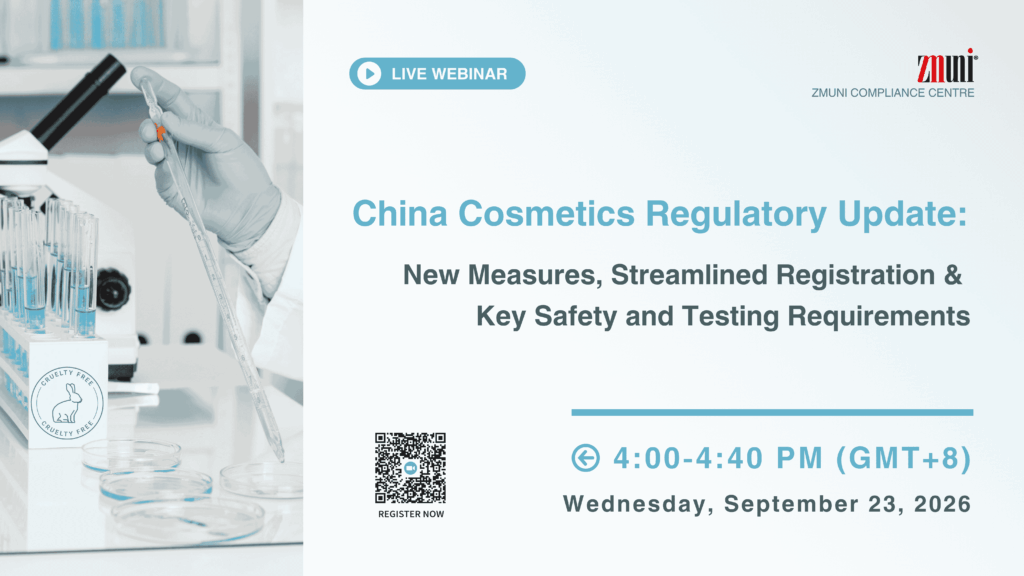
The global cosmetics regulatory environment continues to evolve. To help businesses stay updated with regulatory changes, ZMUni Compliance Center regularly releases a monthly recap of global cosmetics regulations. This article covers the regulatory developments related to cosmetics in China and globally in September 2026, with an emphasis on updates in cosmetic ingredients and cosmetic management, among other areas. China Cosmetic Regulatory Updates New Cosmetics Ingredients (NCI) In September 2026, 12 new cosmetic ingredients were notified with the China National Medical Products Administration (NMPA). They include: The technical requirements for the 12 NCIs mentioned above
From September 21 to 30, a total of five new cosmetic ingredients completed notification with China's National Medical Products Administration (NMPA). The technical requirements for all related NCIs have not yet been publicly disclosed. Sodium Chondroitin Sodium chondroitin is a functional glycosaminoglycan (GAG) found in the extracellular matrix (ECM), where it works with hyaluronic acid and collagen to support ECM homeostasis and mechanical properties. Traditionally used in orthopedics, it has recently gained attention in medical aesthetics and tissue repair. According to Bloomage Biotech, Bloomsac™ Sodium Chondroitin is a non-sulfated polysaccharide produced by microbial fermentation using GRAS
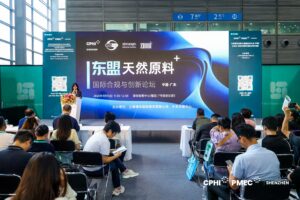
On September 16, 2026, the ASEAN Natural Ingredients International Compliance & Innovation Forum, a key concurrent forum of CPHI & PMEC Shenzhen, was successfully held at the Shenzhen World Exhibition & Convention Center (Futian). Jointly organized by ZMUni Compliance Centre, the China Chamber of Commerce for Import & Export of Medicines & Health Products, and Shanghai Sinoexpo Informa Markets International Exhibition Co., Ltd., the forum brought together industry experts to explore regulatory requirements and market access strategies for novel food ingredients, cosmetics, and health foods across China, ASEAN, and other global markets. Five Sessions, Covering Key Regulatory

On September 24, 2026, the National Institutes for Drug Control (NIDC) issued a notice seeking public comments on information related to 913 existing cosmetic ingredients, including supplementary information such as CAS numbers, structural formulas, molecular formulas, and molecular weights for certain ingredients. Cosmetic companies, ingredient companies, industry associations, research institutions, testing and inspection organizations, regulatory authorities, and other relevant parties are invited to review the information based on the actual application and basic information of the ingredients and submit their comments through the "Information Platform for Existing Cosmetic Ingredients": The deadline for submitting comments is
+86 571 8659 2517
+86 180 5841 8258
info@zmuni.com