

+86 571 8659 2517

+86 180 5841 8258

info@zmuni.com



On September 24, 2026, the National Institutes for Drug Control (NIDC) issued a notice seeking public comments on information related to 913 existing cosmetic ingredients, including supplementary information such as CAS numbers, structural formulas, molecular formulas, and molecular weights for certain ingredients. Cosmetic companies, ingredient companies, industry associations, research institutions, testing and inspection organizations, regulatory authorities, and other relevant parties are invited to review the information based on the actual application and basic information of the ingredients and submit their comments through the "Information Platform for Existing Cosmetic Ingredients": The deadline for submitting comments is
On September 23, 2026, China's National Institutes for Drug Control (NIDC) announced a public call for proposals for the development and revision of 2027 Cosmetic Standards Plan. Organizations and individuals may submit proposals through the Cosmetic Standards Development and Revision Management System on the NIDC website by November 22, 2026. The initiative aims to further improve China's cosmetic standards system in response to regulatory needs and industry developments. The call identifies five priority areas for future standard development and revision: Ingredient safety requirements: Updates to standards for prohibited, restricted, and permitted ingredients, with a focus on
On September 22, 2026, China's National Health Commission (NHC) and the State Administration for Market Regulation (SAMR) announced the release of 50 national food safety standards and amendment sheets. The package includes 30 food safety standards covering food ingredients, food additives, contaminant control, analytical methods, and special dietary foods, as well as 20 amendment sheets to existing food safety standards. The standards were officially issued on August 18, 2026, with implementation dates ranging from February to August 2027. 30 Food Safety Standards GB 31688-2026 – Milk Protein GB 22570-2026 – Complementary Food Nutritional Supplements and

In September 2026, KANS, a famous Chinese skincare brand under Shanghai Chicmax Co., Ltd., successfully obtained approval from the Indonesian Food and Drug Authority (BPOM) for its self-developed cosmetic ingredient Cyclohexapeptide-9. The approval allows Cyclohexapeptide-9 to be included in Indonesia's cosmetic ingredient database, enabling cosmetic products formulated with the ingredient to proceed with the local notification process, subject to other applicable regulatory requirements. [Certificate of Approval for the Cosmetic Ingredient from BPOM] From R&D to Market Access: The International Regulatory Pathway of Cyclohexapeptide-9 Independent R&D → INCI naming → China new cosmetic ingredient notification → BPOM

On September 20, 2026, China's General Administration of Customs of China (GACC) released information on food products denied entry at Chinese ports in August 2026. According to the data, 755 batches of food products that failed to meet safety, hygiene, or other relevant requirements and were therefore denied entry, representing an approximately 55% month-on-month increase from 487 batches in July 2026, an increase of 268 batches. The figure also increased by approximately 22% year-on-year, compared with 617 batches during the same period last year. The 755 batches covered a wide range of product categories, including beverages, alcoholic beverages,
From September 1 to 17, a total of seven new cosmetic ingredients completed notification with China's National Medical Products Administration (NMPA). The technical requirements for all related NCIs have not yet been publicly disclosed. Shikimic acid Shikimic acid is a naturally occurring organic acid. IIt is widely found in plants, particularly in the fruits of Illicium species such as star anise. In the pharmaceutical field, shikimic acid is of significant value as a key starting material for the synthesis of the anti-influenza drug oseltamivir (brand name: Tamiflu). With the development of biotechnology, microbial fermentation has gradually

Cross-border e-commerce (CBEC) has made it easier for overseas dietary supplement brands to reach Chinese consumers without following the conventional import and market-entry route. However, CBEC does not remove the need to meet applicable Chinese requirements. For products containing novel, functional, or otherwise sensitive ingredients, compliance considerations may arise across ingredient status, formulation, import documentation, labeling, online claims, and post-import operations. In other words, a product legally sold as a dietary supplement in another country cannot necessarily be marketed in China through CBEC in the same way. Ingredient Status Is Often the Starting Point For

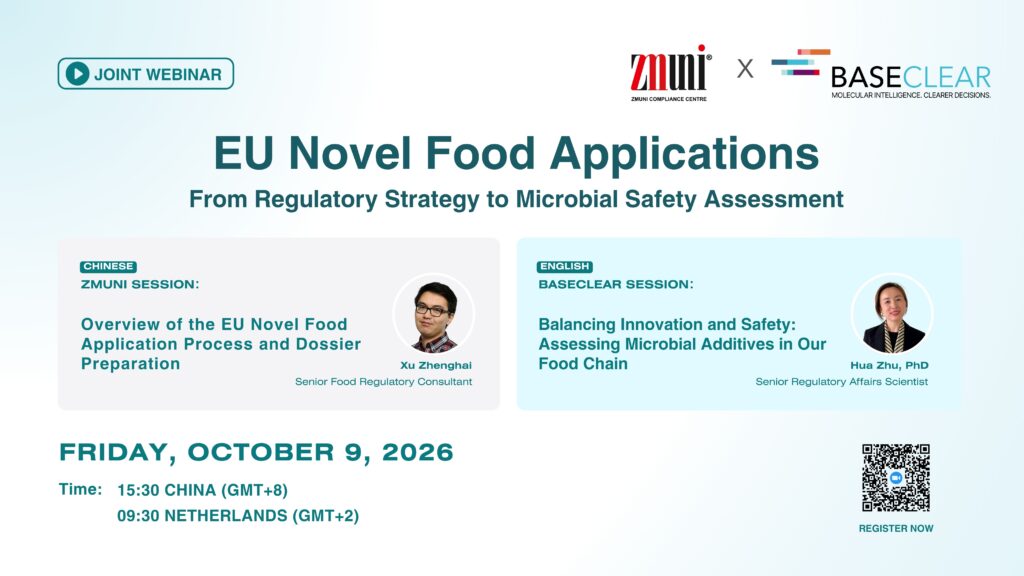
In August 2026, a novel food for which ZMUni Compliance Centre provided end-to-end regulatory and technical services successfully passed the technical review conducted by a Thai-accredited safety assessment body and received an approval letter from the Thai Food and Drug Administration (Thai FDA). Thai FDA Approval Letter 1. Thailand's Positive List for Novel Foods "Publicly Listed" Does Not Mean "Generally Applicable" In May 2026, the Thai FDA published a list of novel and non-novel foods that have undergone safety assessment. The list covers a number of ingredients that have attracted significant market attention, including human
+86 571 8659 2517
+86 180 5841 8258
info@zmuni.com